 Mirror Health
Loneliness and Social Skill Growth
In this Reflection post I would like to identify loneliness as a real threat to physical and mental wellbeing. In 2023 the US Surgeon General declared loneliness an epidemic, and I use material from that publication here. After exploring the significance of loneliness, I would like to provide a framework for developing social skills.
Loneliness
Loneliness is not the same as isolation. Isolation means literally being separated from others. Loneliness can occur in isolation or when you are around others. It is a feeling that you don't have close relationships and are not understood well by others.
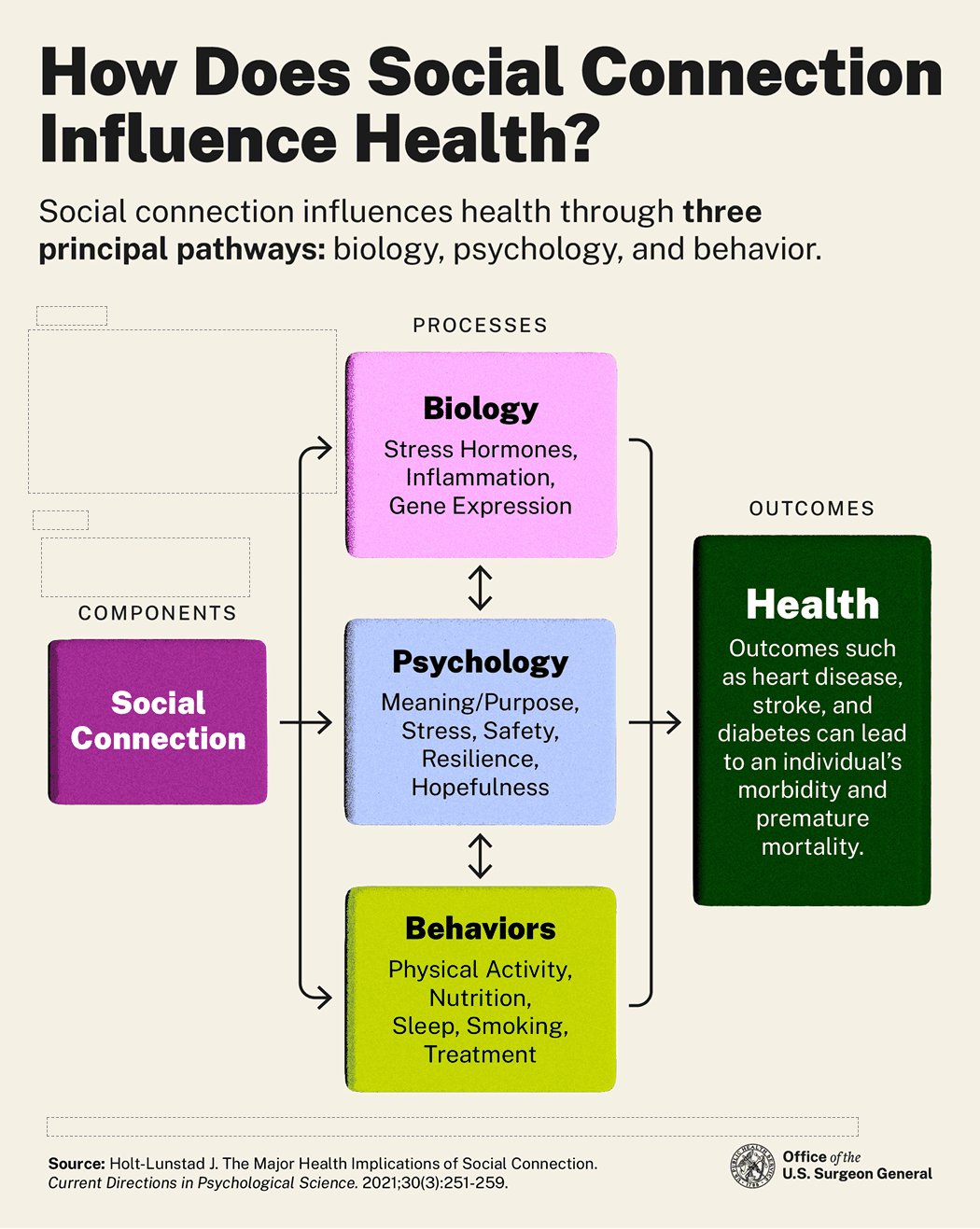
In 2023 the US Surgeon General published "Our Epidemic of Loneliness and Isolation". There it is stated that loneliness is associated with a greater risk of cardiovascular disease, dementia, stroke, depression, anxiety and premature death. It can be equated to smoking 15 cigarettes per day (page 4).
148 studies, with an average duration of 7.5 years of follow-up, suggest that social connection increases your odds of survival by 50% (page 24).
Clearly this is an important topic.
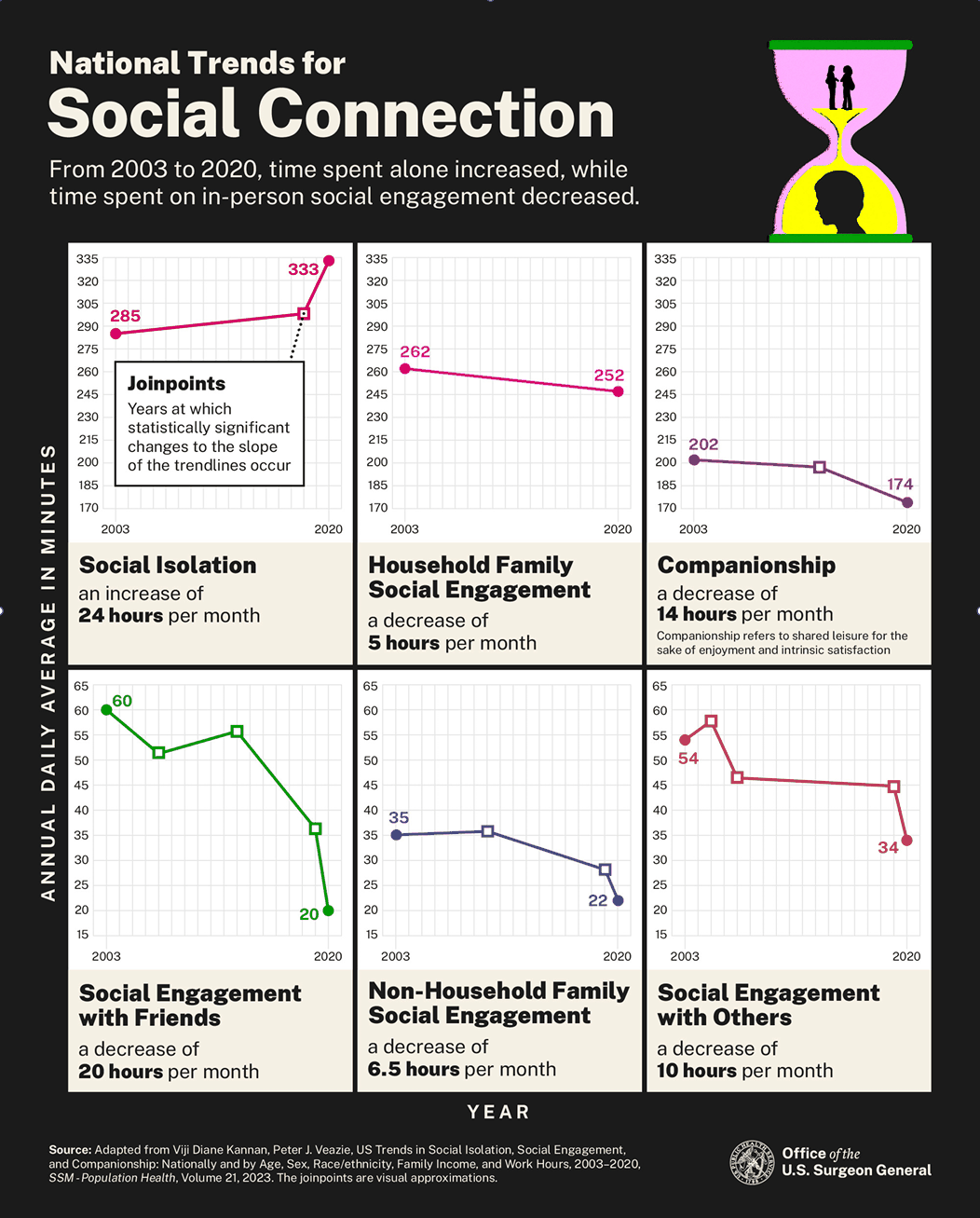
Clearly the advancement of technology is leading to isolation. Those who report using social media for more than 2 hours per day were twice as likely to report perceptions of social isolation as those who used social media for less than 30 minutes per day (page 20).
The material that we interact with has lost its social connection. Imagine all material around you had an origin that was tangible, local and related to a social connection. Material nihilism trades this meaningful connection to provide an abundance of material.
Where to Start
Social skills develop across a lifetime, and some people acquire them more naturally than others. Our earliest relationships, particularly those with our primary caregivers, help shape the expectations, emotional responses, and patterns we bring into later relationships. For some, this early attachment provides a secure foundation from which they can develop independence and form healthy connections with others. For others, relational patterns learned early in life may become limiting or problematic, eventually leading them to seek new ways of connecting. I have seen patients recognize and reconsider these patterns from age 18 into their 70s. I deeply admire those who remain willing to examine and change their ways of relating, even later in life.
To build a framework for social skills, I recommend patients read C.S. Lewis's The Four Loves and The Temperament God Gave You by Art and Laraine Bennett.
The Four Loves
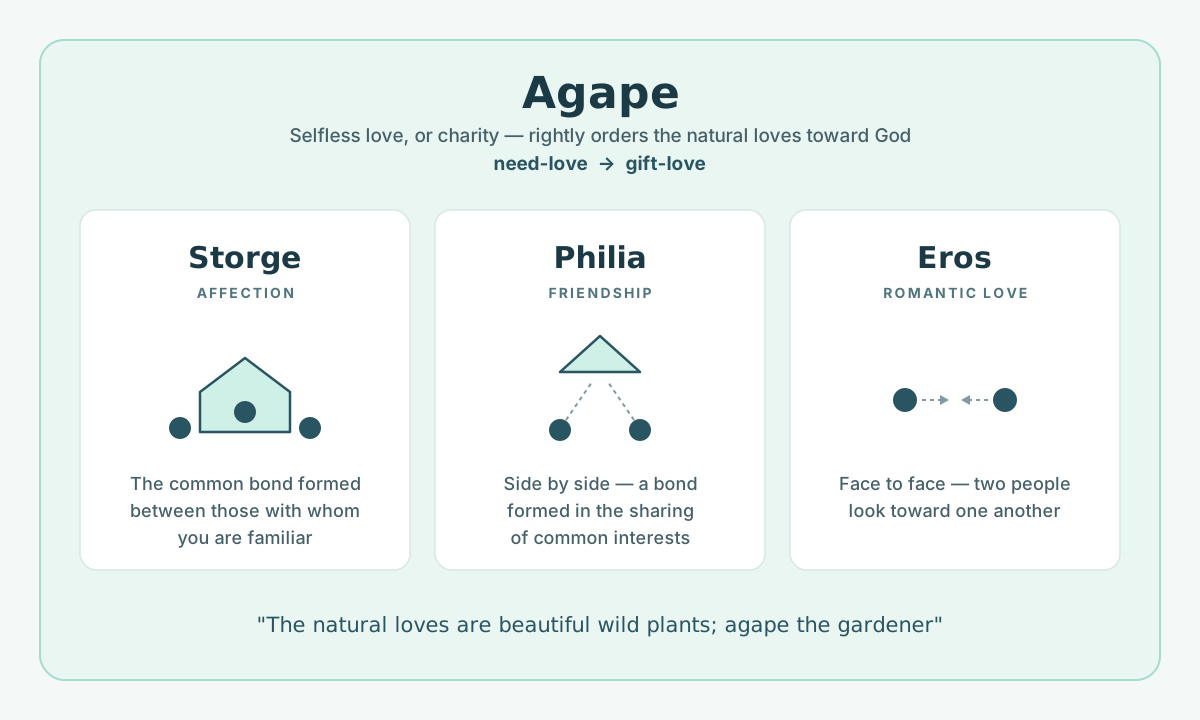
Storge is the common bond formed between those with whom you are familiar.
Philia is friendship. The bond of friendship occurs in the sharing of common interests. Imagine two friends at the precipice of a mountain, looking down at the valley. They aren't speaking, but they both sense the eternal in the landscape. Rarely do they look toward their relationship.
Eros is romantic love. Here is where two people look toward one another. Passion is found here and can even be measured by its absurdity. The more irrational your response to Eros, the stronger your love.
Agape rightly orders the other three loves toward God. Agape is selfless love, or charity. Agape turns "need-love" to "gift-love" — from a love that demands reciprocation to one that expects nothing in return. The natural loves are beautiful wild plants, agape the gardener. Among the weeds are idolatry, possessiveness, jealousy, exclusivity and resentment.
The Four Temperaments
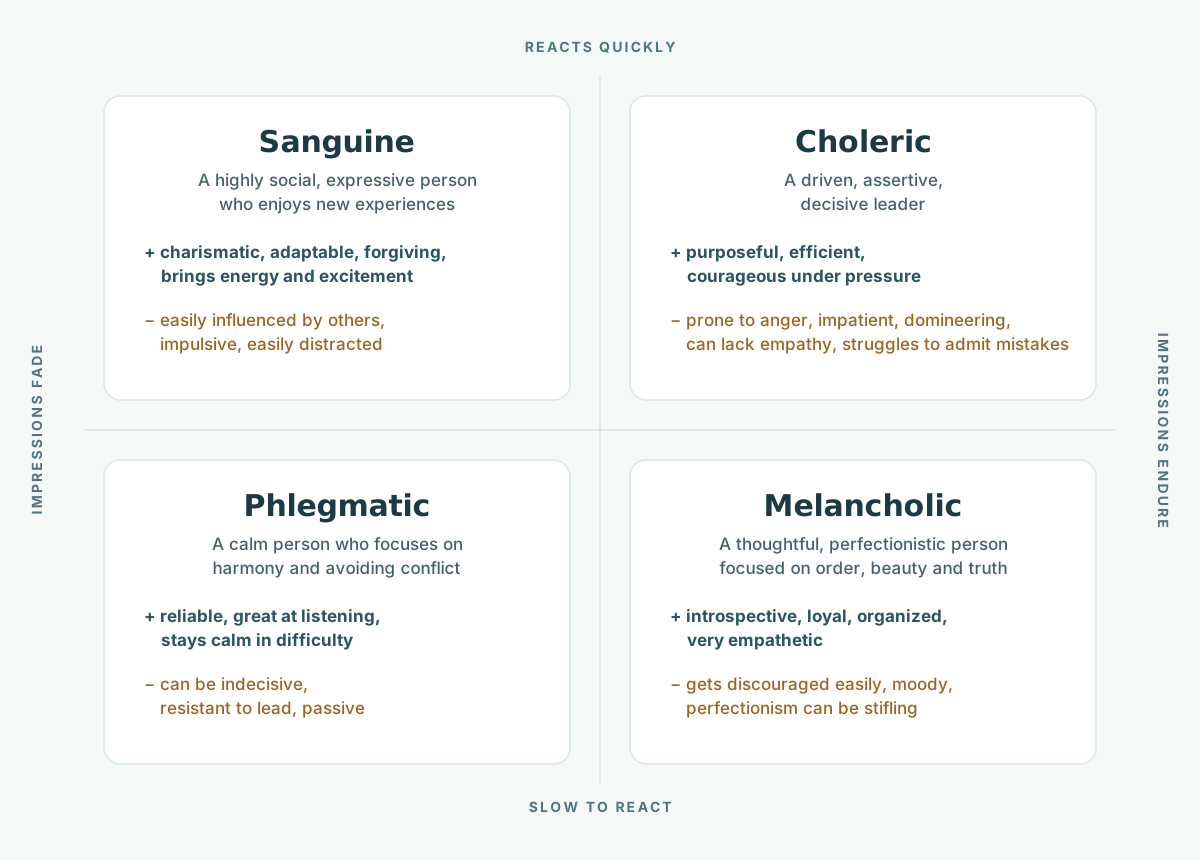
The Four Temperaments are a way of understanding how others see the world. Each has their positives and negatives. Jesus is understood to have been the full embodiment of the positives of all four temperaments. People are often either one or a split between two of these. Myers-Briggs personality typing is based off of these original temperaments.
Choleric: a driven, assertive, decisive leader.
Positives: purposeful, efficient, courageous under pressure.
Negatives: prone to anger, impatient, domineering, can lack empathy, struggles to admit mistakes.
Sanguine: a highly social and expressive person who enjoys new experiences.
Positives: charismatic, adaptable, forgiving, brings energy and excitement.
Negatives: vulnerable to the influence of others, impulsive and easily distracted.
Melancholic: a thoughtful, perfectionistic person who is focused on order, beauty and truth.
Positives: introspective, loyal, organized, very empathetic.
Negatives: gets discouraged easily, perfectionism can be stifling, moody.
Phlegmatic: a calm person who focuses on harmony and avoiding conflict.
Positives: reliable, great at listening, stays calm in difficulty.
Negatives: can be indecisive, resistant to lead, and passive.
For those with high social anxiety, my advice is to ask yourself, "What do I know about this person?" and "What do I want to know about this person?" Those two questions can help you to not idealize people and then to empathize while getting to know them.
Social Strategy
- When in a social situation, ask yourself, "What do I know about this person?" "What do I want to know about this person?" Those two questions can help you to not idealize and then to empathize in a way that helps you get to know them genuinely.
- Diversify the places you receive social feedback. We are social creatures, and how others treat us matters to some extent to everyone! If you are only seeing a few people in one context per week, that interaction takes on an outsized importance.
- Relationships have a rhythm. You see someone at work you have general affection for — Storge. The rhythm involves involuntary proximity at work. To move the relationship to Philia would change the rhythm and deepen the relationship. With the knowledge of Philia as based on common interest, you invite the person to something you both mutually enjoy.
- Relationships have boundaries. There is risk in changing the rhythm of a relationship. If the person says no and does not want to move beyond Storge, respecting that decision while maintaining Storge is a healthy response to their boundary.
- In this way relationships are very much like a dance. In other ways, they are like an organism that requires nourishment and attention to continue to survive.
Conclusion
I began writing this with the intention of discussing loneliness, but I don't think it is necessary to expound upon something that we all inherently know is bad for us. So this has morphed into social skills advice that I hope is helpful to those looking to develop this particular skill.
Source: Office of the U.S. Surgeon General. Our Epidemic of Loneliness and Isolation: The U.S. Surgeon General's Advisory on the Healing Effects of Social Connection and Community. U.S. Department of Health and Human Services; 2023. Infographics reproduced from the advisory.